
Blog • YouTube
How to Write a YouTube Script Hook in 3 Steps
A three-step method for the first 30 seconds of a YouTube script, using two real AI-written Blockbuster openings to show what works and what doesn't.
The first thirty seconds of a video decide whether people stay. A hook is not a greeting or a summary. It is a reason to keep watching.
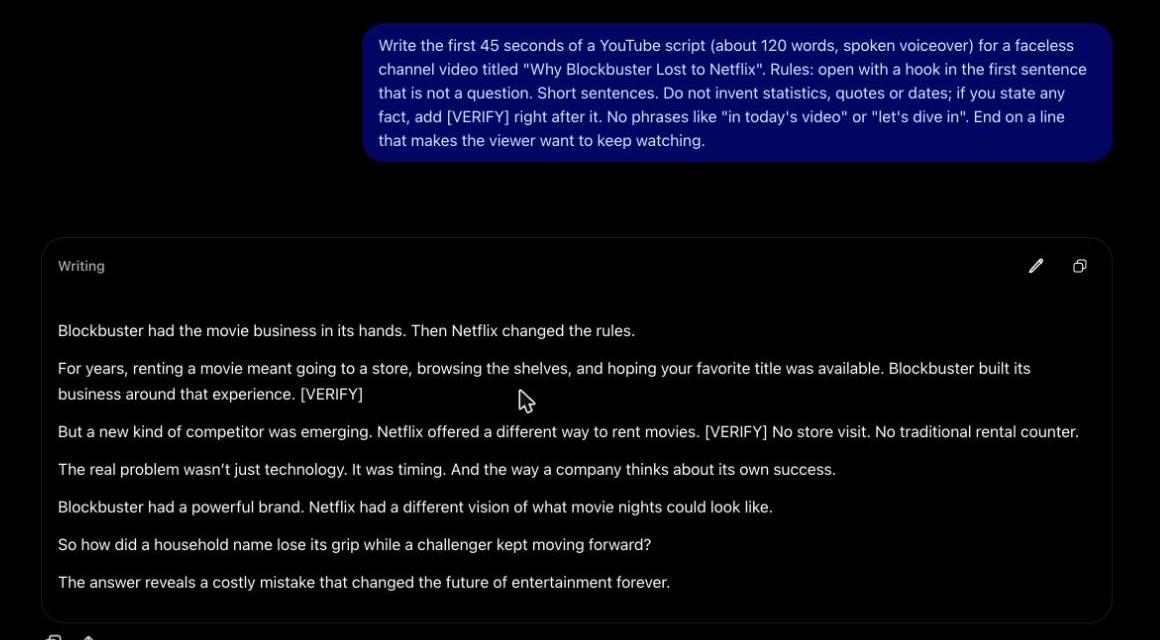
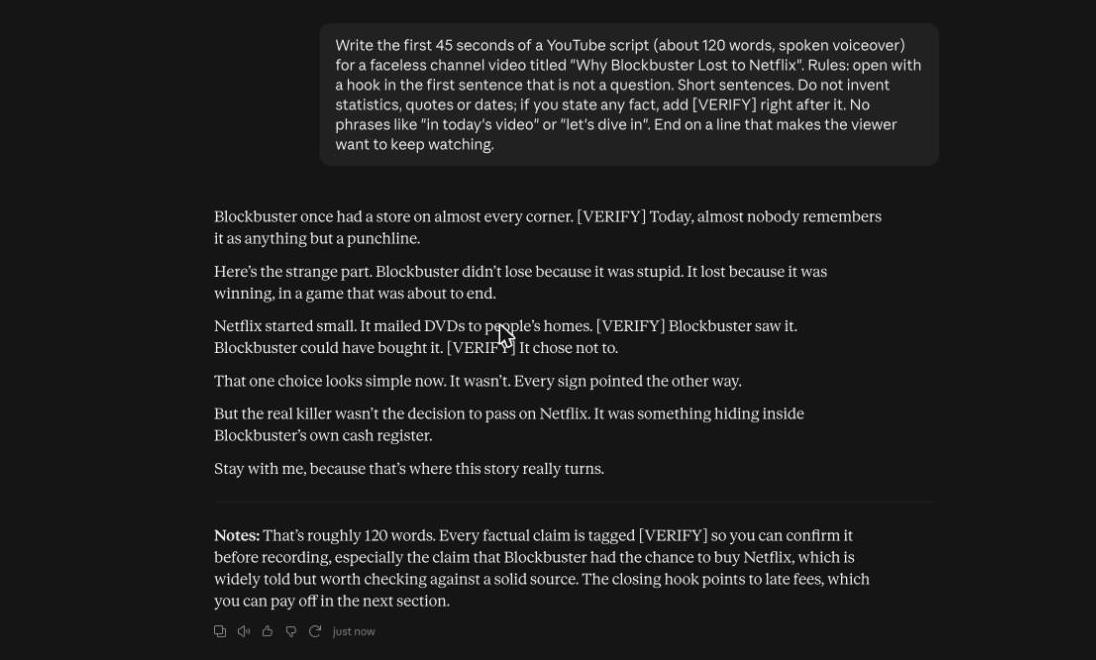
Here is a three-step method, illustrated with two openings I generated for the same video: "Why Blockbuster Lost to Netflix". The test is described in full in my post on ChatGPT vs Claude for scripts. The prompt asked for no question as the first sentence and no stock phrases.
Step 1: Start with a tension, not a topic
A topic is "Blockbuster and Netflix". A tension is something that doesn't add up.
One of the openings began: "Blockbuster had the movie business in its hands. Then Netflix changed the rules." It is clean, but it announces a topic. You could put it on any business video.
The other began: "Blockbuster once had a store on almost every corner. Today, almost nobody remembers it as anything but a punchline." That sets up a gap between what the company was and how people see it now. The viewer wonders how that happened.
Step 2: Make a claim the video will have to prove
The stronger opening went on to say that Blockbuster "didn't lose because it was stupid. It lost because it was winning, in a game that was about to end." That is a claim. It might be wrong, and the video now has to show it.
A hook that makes a claim gives the viewer something to test. A hook that only describes gives them nothing to wait for.
The warning: a claim in a hook raises the stakes for your facts. Every concrete statement needs a source before you record. In the earlier test, the key claim, that Blockbuster could have bought Netflix, matched the reporting I checked.
Step 3: Close the loop open
End the hook on something specific you haven't explained yet. The stronger version ended with "something hiding inside Blockbuster's own cash register", which pointed to a real thing the video could explain later: late fees.
The other version closed with "a costly mistake that changed the future of entertainment forever". That is a promise with no detail, and viewers have heard it many times.
A good test is whether the viewer could guess what comes next. If they can, you've explained too much. If they have no idea, you've explained too little. A specific teaser sits in between.
A quick checklist
- First sentence is a statement, not a question, and not a greeting.
- It contains something surprising or contradictory.
- There is a claim the video will prove.
- No "in today's video", no "let's dive in", no "before we start".
- The last line points at something concrete.
- Every fact in it has a source.
Writing it with AI
Use a prompt with the rules built in, then rewrite it in your own words:
Write the first 45 seconds of a YouTube script (about 120 words, spoken voiceover) for a faceless channel video titled "[TITLE]". Rules: open with a hook in the first sentence that is not a question. Short sentences. Do not invent statistics, quotes or dates; if you state any fact, add [VERIFY] right after it. No phrases like "in today's video" or "let's dive in". End on a line that makes the viewer want to keep watching.
The takeaway
A hook gives a tension, makes a claim and leaves a specific question open. The AI can draft one, but you have to check the facts and make it sound like a person.