
Blog • Freelancing
How to Write a Cold Email to a Small Business That Gets Replies
A short cold email template for freelancers with no past clients, built with AI and edited by hand, plus the honest way to handle having no experience.
Most cold emails from freelancers fail for the same reason: they are about the freelancer. "I'm a passionate writer with a track record of..." The person reading is a busy owner who wants to know one thing. Is this relevant to me?
If you have no clients yet, you have an extra problem: you can't lean on a track record. The honest way through is to be short, be specific, and offer something small. Here is how I'd do it, and the draft an AI produced.
The prompt
Write a cold email to the owner of a small local bakery offering to write product descriptions for their website. Facts I can state: I'm a freelance writer, and I have one portfolio piece I can link. I have no past clients, so do not imply any. Rules: under 100 words, no flattery, no 'I hope this finds you well', one specific observation about their business written as the placeholder [OBSERVATION: something real from their website or shop], and end with one easy yes/no question. Also give 3 subject lines.
Three rules are doing the work: only the facts you can state, a placeholder for the specific observation, and one yes/no question at the end.
What came back
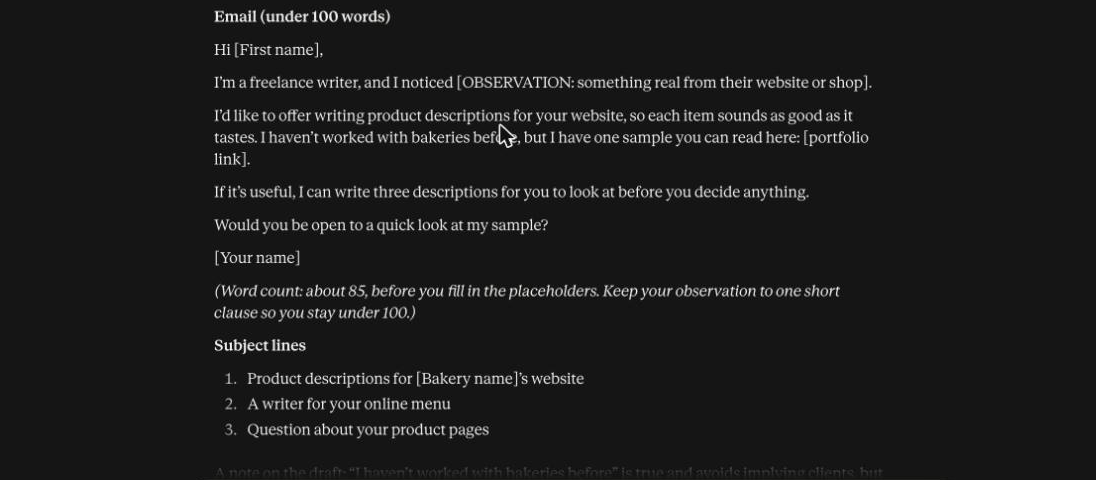
The draft was about 85 words. It opened with "I'm a freelance writer, and I noticed [OBSERVATION]", offered to write three descriptions to look at before the owner decides anything, and ended with "Would you be open to a quick look at my sample?" It did not imply past clients, and it said plainly: "I haven't worked with bakeries before, but I have one sample you can read here." The subject lines were short and plain, such as "Product descriptions for [Bakery name]'s website".
What I'd change
- Cut "so each item sounds as good as it tastes". It is the line every food copywriter writes. Replace it with something about their actual products.
- Make the observation the opening. It is the only proof that the email was written for them. Something like "Your menu lists 'sourdough' with no description" is real and specific.
- Decide about the sentence "I haven't worked with bakeries before". It is honest. It also tells them you're new. I'd keep it, since being straightforward is the point, but it is your call. The AI offered the same choice.
Make the observation real
Spend two minutes on their website or shop before you write. Look for one thing: a product with no description, a description that is one word, a typo, a menu that doesn't say what's in anything. Write that down. Without it, the email is a template, and owners can tell.
What to send, and when
- Send it on a weekday morning, to a named person if you can find one.
- Use your real name and a real email address.
- Follow up once, a week later, with one line. If there's still no reply, leave it.
- Cold email rules differ by country, and business emails are regulated in some places. Check the rules where you and the recipient live, and include a simple way to say "no thanks".
What a first offer can look like
When you have no clients, a small, specific, low-risk offer works better than a pitch. In the draft it was "three descriptions for you to look at before you decide anything." You are giving them something to judge, rather than asking them to trust you. Only offer what you are happy to do for free.
The takeaway
A cold email works when it is short, specific to them, and honest about who you are. Let the AI draft the structure, then put in the one detail only you can add: something you noticed about their business.