
Blog • Freelancing
How to Write a Case Study When You Have No Clients
How to build an honest portfolio piece when you have no clients yet, using a clearly labelled example brief instead of invented results.
The advice for new freelancers is "build a portfolio". The problem is that a portfolio normally shows client work, and you don't have any. The tempting shortcut is to invent clients or results. Don't. It is easy to get caught, and it is hard to recover from.
There is an honest way to do it. You show how you work, using an example you label as an example.
What to call it
Be plain about what the piece is. I use labels such as:
- "Portfolio piece" with the form of the work (for example, a LinkedIn post or a blog post).
- "Based on publicly reported facts" if the piece uses real information.
- "Example brief" if the project you responded to is one you wrote yourself.
You don't need to apologise for these. A buyer who sees a clear label trusts you more than one who suspects a made-up client.
The structure
A good case study, even an unpaid one, has four parts:
- The brief. What was asked for. If you wrote it, say so.
- Your approach. How you went from the brief to the piece, including the questions you would ask the client.
- The piece itself. The actual work, shown in full or as an excerpt.
- What you would do next. What you'd test or improve with real feedback.
Notice that "results" isn't on the list. You don't have results, so don't write any.
An example brief
Here is the kind of example brief I'd use for a writing portfolio:
A water bottle brand selling mostly to students needs product descriptions for four bottles. Tone: fun but not cringe. Launching in a few weeks.
I used a message like this in an earlier post. I gave it to an AI with a prompt that turned it into a one-page brief and a list of nine questions, from "how long should each description be?" to "who approves the final copy?".
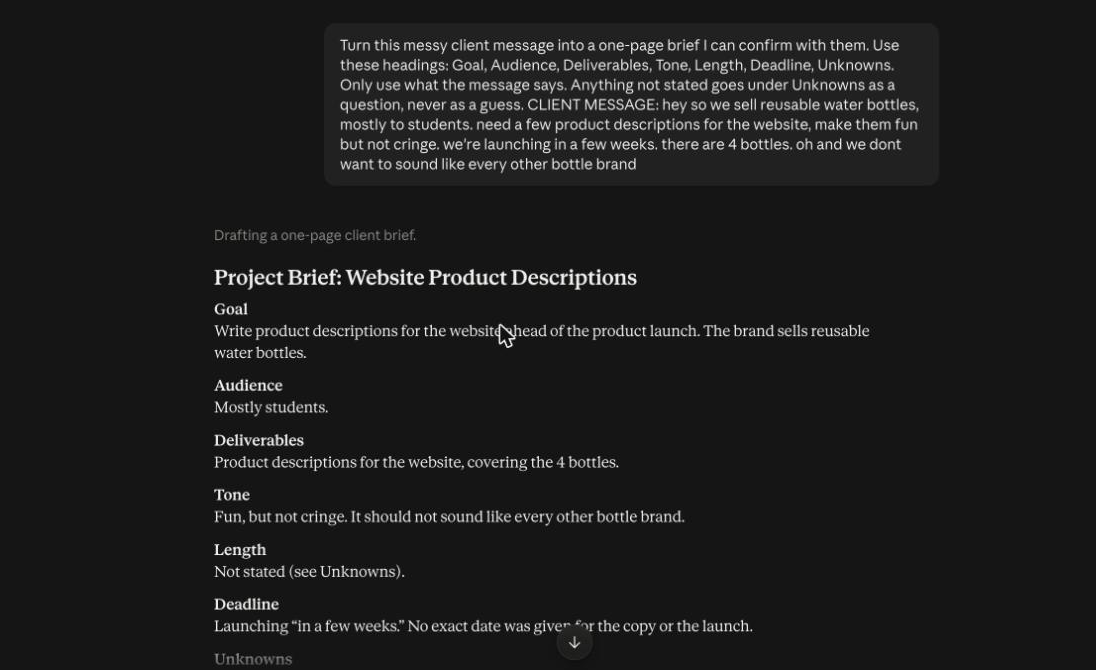
That list of questions is itself part of the case study. It shows how you think before you write.
How to write the approach
Write in the first person, in plain words, and describe real steps:
- What I read first, and what I noticed.
- What I would have asked a real client, and why.
- What I decided without being able to ask, and what assumptions I made.
- How I checked the work against the brief.
If you used AI for part of it, say which part. That is more honest, and many buyers prefer to know.
What not to do
- Don't invent a client name, logo or quote. Not even a "friendly" one.
- Don't write results you didn't get. "Increased engagement by 40%" is the fastest way to lose a buyer's trust.
- Don't hide the label in small print. Put it where the reader sees it.
- Don't use someone's real work without permission. Rewriting a real company's page is fine as practice, but label it as unsolicited.
Where to put it
A one-page site, a PDF, or the portfolio section on a freelance platform. Three solid pieces are enough to start. Quality and honesty matter more than quantity.
The takeaway
You can't show client results you don't have, but you can show how you think. A clearly labelled example, with your questions, your approach and the work itself, is a real case study.