
Blog • Editing
How to Proofread AI Writing: A 10-Minute Checklist
A practical checklist for editing AI-written text, plus a test showing what the AI found wrong with a buzzword-heavy paragraph.
AI writing is usually grammatically perfect and often empty. Spelling mistakes are rare. The problems are different: stock phrases, claims with nothing behind them, and sentences that sound important and say nothing.
Here is the checklist I use, and a test that shows why it matters.
A test paragraph
I wrote a paragraph in the style AI often produces by default:
In today's fast-paced digital landscape, it is crucial to leverage cutting-edge AI tools to unlock your full potential. Moreover, it is important to note that seamless workflows can delve into game-changing efficiencies. Furthermore, businesses that embrace AI will undoubtedly thrive.
Then I asked Claude to list what was wrong with it and rewrite it in plain language without adding facts.
Edit this paragraph. First list what is wrong with it (empty phrases, vague claims, filler transitions). Then rewrite it in plain language without adding any facts that are not in it. If the paragraph says nothing specific, tell me so instead of inventing content.

PARAGRAPH: [paste]
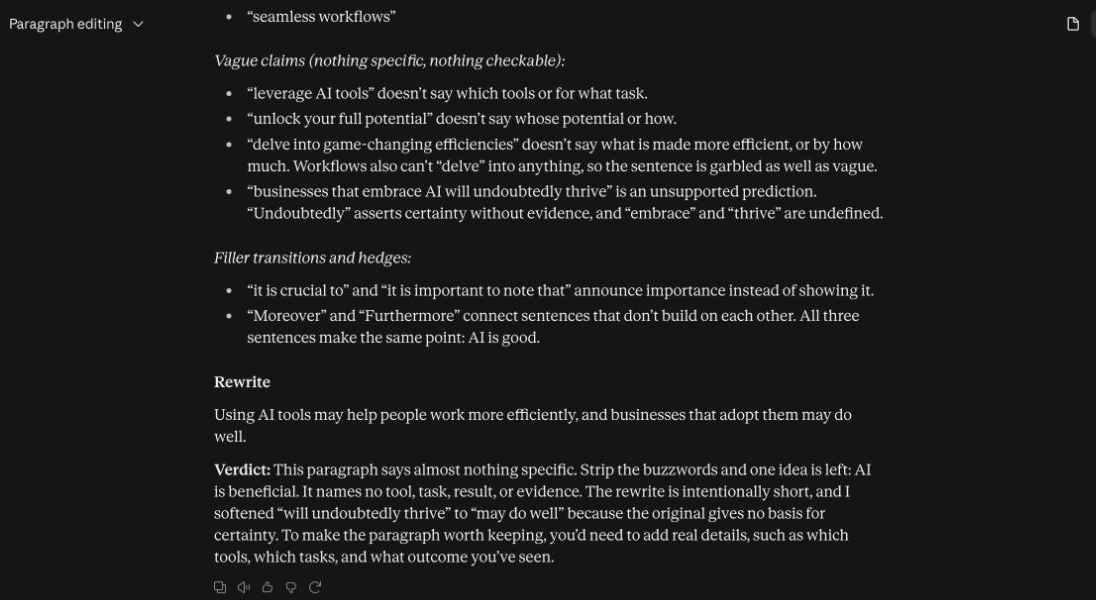
It sorted the problems into three groups: empty phrases ("cutting-edge AI tools", "seamless workflows"), vague claims ("leverage AI tools" says neither which tools nor what for), and filler transitions ("Moreover", "Furthermore" joining sentences that do not build on each other). It also noticed that "workflows can delve into game-changing efficiencies" is not just vague but garbled: workflows can't delve into anything.
The rewrite was one short sentence. The verdict explained why: the paragraph says almost nothing, and after you strip the buzzwords there is one idea left, that AI is beneficial.
That is the most useful result. Sometimes the right edit is to delete the paragraph or give it something real to say.
The 10-minute checklist
Minutes 1-2: Read it aloud. Mark every sentence you would not say to a person.
Minutes 3-4: Cut the stock phrases. Search for these and rewrite or delete them: "in today's", "it is important to note", "it is crucial", "landscape", "leverage", "unlock", "game-changer", "seamless", "delve", "moreover", "furthermore", "ultimately", "at the end of the day".
Minutes 5-6: Check for empty claims. For each sentence, ask: could someone prove this wrong? If not, make it specific or cut it.
Minutes 7-8: Check the facts. List the numbers, dates, names and "studies show" claims, and verify them against a source, as in the earlier post on fact-checking.
Minutes 9-10: Add something only you know. A real example, a number from your own work, a mistake you made. This is what makes it yours.
Patterns worth knowing
- Three of everything. AI loves lists of three ("faster, smarter, better"). Break the pattern when it isn't natural.
- Every paragraph ends with a lesson. Cut the last sentence and see if the paragraph still works.
- Over-balanced sentences. "While X, it's also important to consider Y." Pick the one you mean.
- Safe verbs. "Enhance", "streamline", "foster". Replace with the actual action.
What not to do
Don't run another AI tool to "humanise" the text. It tends to swap one set of stock phrases for another. Edit by hand, and keep the changes small.
The takeaway
Proofreading AI writing is less about fixing mistakes and more about removing filler and adding substance. If you can't find anything specific to add, the piece probably isn't worth publishing.